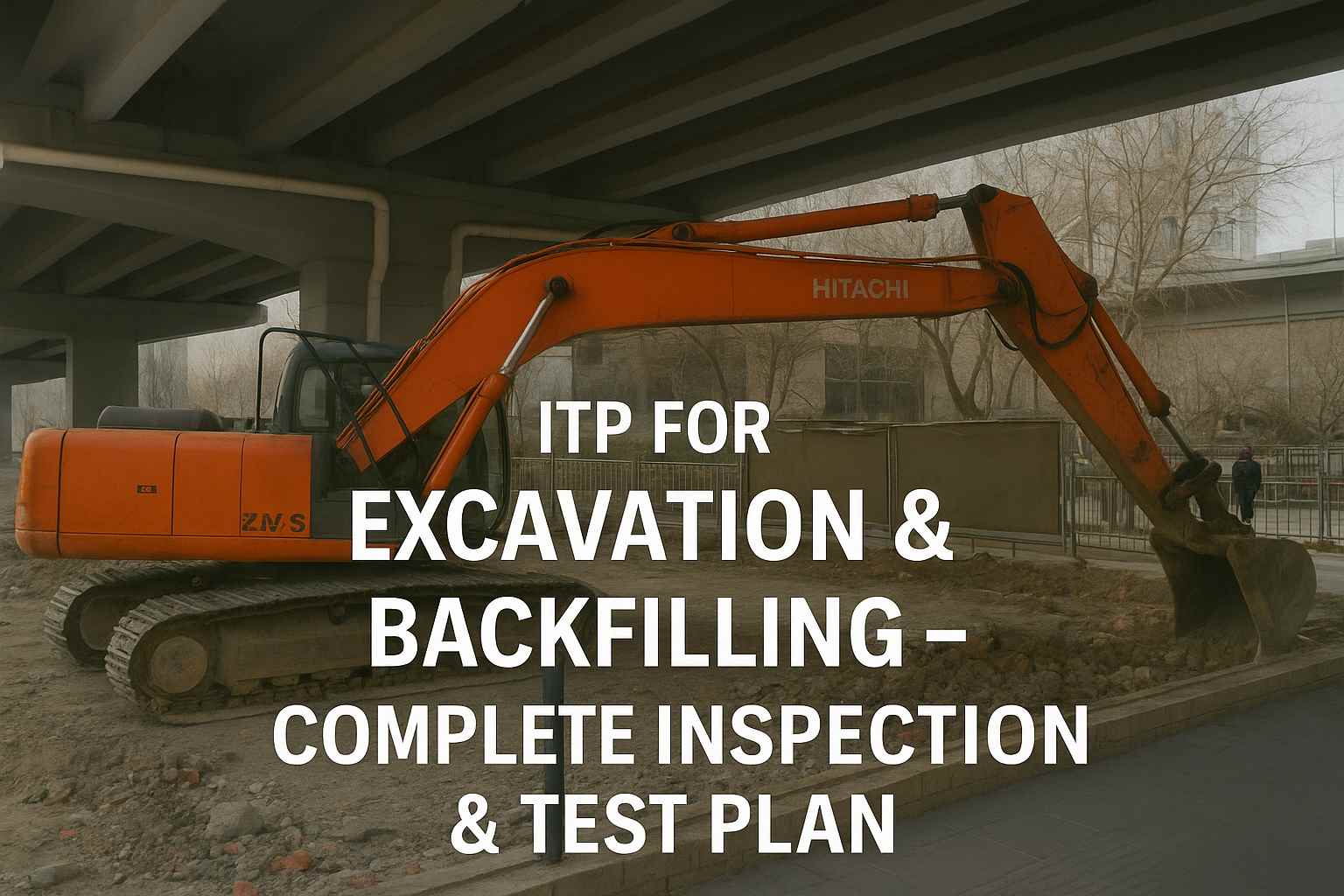
Excavation and backfilling form the foundation of any civil or structural work, and even a small mistake at this stage can affect the entire project that comes above it. To maintain accuracy, ensure quality, and follow the approved drawings and specifications, a clear Inspection & Test Plan (ITP) is required.
Inspection & Test Plan (ITP) for Excavation & Backfilling provides a step-by-step framework covering all essential checks—from reviewing documents and verifying equipment, to monitoring excavation, backfilling, compaction, and final levels. It also includes all necessary registers and reporting formats to record the inspections properly.
The objective of this document is to ensure that every activity is carried out in a systematic manner, meets the project requirements, follows safety guidelines, and maintains full traceability of workmanship and materials throughout the process.
WHAT IS AN INSPECTION AND TEST PLAN (ITP)
Inspection and Test Plans and checklists are integral parts of quality management systems — not only in construction but in almost every industry where Quality Management Systems (QMS) are implemented.
They are considered master documents through which various parameters and activities of a process are monitored and recorded. These records later play a vital role during verification and auditing.
In construction, where numerous trades and activities must be completed — such as structural, finishes, façade, electrical, mechanical, and plumbing works — preparation and implementation of different ITPs form a crucial part of the project quality management system.
To read more about ITPs and how to prepare one, CLICK HERE and refer to the last picture in this post for a quick understanding of an ITP’s structure and how to align it with your project requirements.

INSPECTION AND TEST PLAN FOR EXCAVATION & BACKFILLING WORKS
SECTION 1 – DOCUMENTATION REVIEW
This section outlines the review and approval process for all necessary documents before commencing on-site excavation work.
Key documents include:
- Approved drawings and typical details
- Logistics for incoming materials and disposals
- Plant, machinery and vehicle details
- Method Statement
SECTION 2 – INSPECTION OF EQUIPMENT
This section outlines the review and approval process for all necessary documents before commencing Cement Plastering works on-site.
Key checks include:
- Excavators, Dumpers/tippers, Dewatering pumps
- Survey equipment
- Material for earthwork filling works
SECTION 3 – PRE-WORK INSPECTION
This section focuses on inspections to be carried out before the excavation and subsequent backfilling work begins to ensure all prerequisites are met
Checks include:
- Check for the establishment of permanent benchmarks
- Check for the establishment of benchmarks.
- Check for setting out
- Barricading
- Tree numbering plan & Cutting/transplanting.
- Fix the founding levels (Depth of excavation)
SECTION 5 – WORK IN PROGRESS INSPECTION
During work in progress, regular inspections are conducted to ensure that the work meets acceptable quality standards.

Checks typically include:
- Check for the cutting of trees
- Check for clearing and stripping
- Check for filling of holes and hollows
- Check for levels for excavation & Cutting
- Check during excavation
- Check for de watering
- Check for benching/ Slope of pit sides to prevent sliding in.
- Check for filling material
- Check during filling.
- Check for excavation in excess of depth
- Check for protection of buried pipelines and cables
- Check for storage of excavated materials
- Check for preparation for foundations
- Check for foundation layout
These inspections help prevent defects and ensure that excavation and subsequent backfilling work meet quality requirements.
SECTION 5 – CHECK FOR BLASTING IF ANY
After work is completed, an inspection ensures that the finished area for
Checks include:
- Check for approval for blasting
- Check for blasting materials
- Check for use on Dynamite, gelatin, or other high-explosive material
- Check for safety precautions.
SECTION 6 – POST-WORK INSPECTION
After work is completed, an inspection ensures that the finished work
Checks include:
- Final Level
- Check for surplus materials
This ITP ensures that all excavation and backfilling activities are carried out with accuracy, safety, and full adherence to project specifications. By following the defined inspections and tests—from initial benchmark verification to final compaction checks—the plan reduces the risk of settlement, structural distress, and long-term performance issues. When implemented properly, this ITP acts as a dependable quality-control framework, ensuring stable ground preparation and a solid, durable base for all subsequent construction works.
Sign up below to download the full editable Inspection and Test Plan (ITP) for Excavation & Backfilling, which contains
- Dumper / Tippers Trip record
- Foundation layout
- Levelling Report
- Compaction Report – Field Dry Density