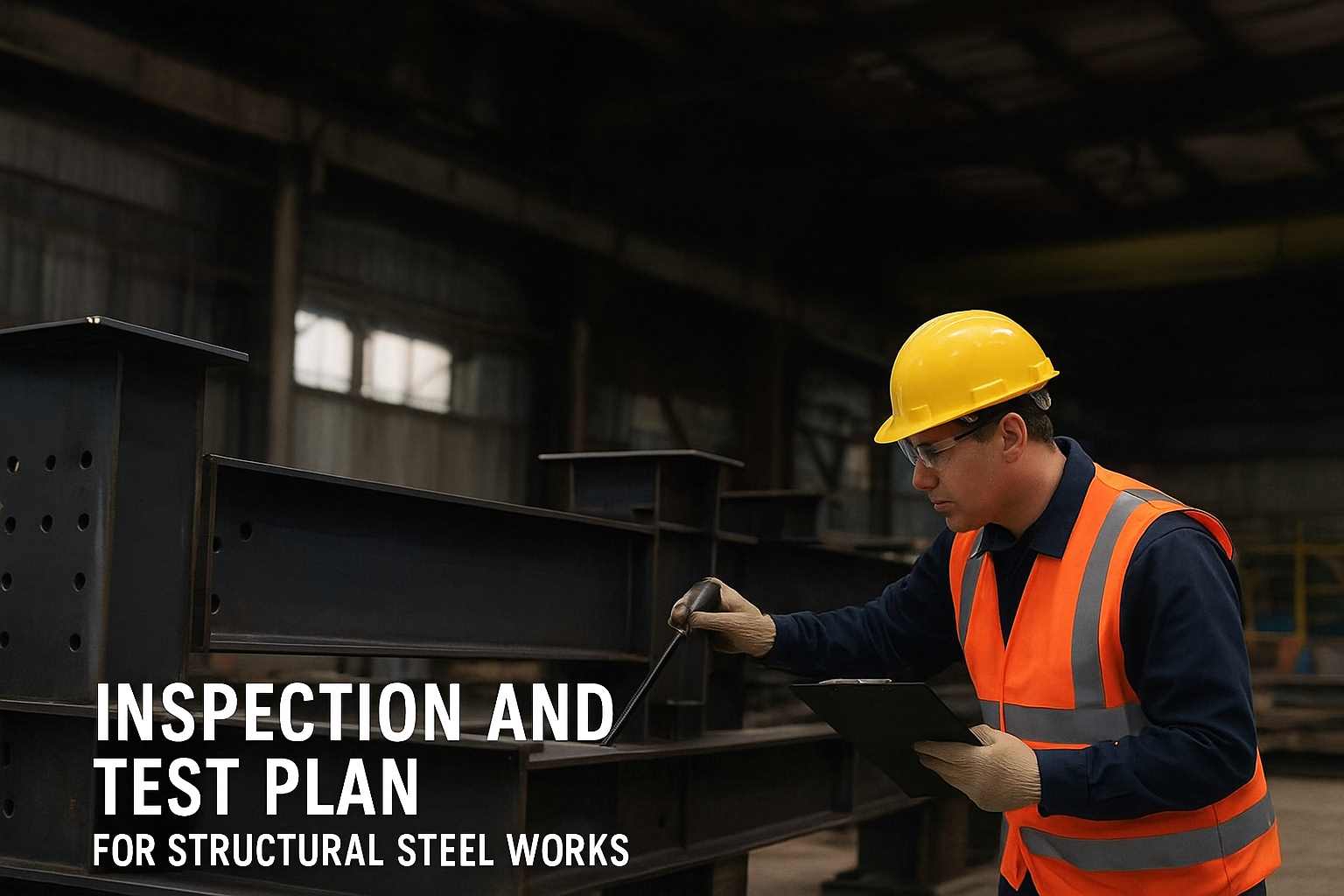
This post explains the necessary inspections and testing required during the fabrication of structural steel works. This is only a summary, and a fully customizable ITP with the required checklist in Word format can be downloaded from the link given at the bottom.
Click Here for the ITP for Structural Steel Works Erection.
WHAT IS STRUCTURAL STEELWORK
Structural steel is one of the most important materials in the construction industry. It is used in many structures — in fact, heavy structures like buildings, factories, bridges, etc.
Structural steelwork involves reshaping and fabrication of steel through cutting, bending, and assembling into the required structural shapes.

WHAT IS AN INSPECTION AND TEST PLAN (ITP)
Inspection and Test Plans and checklists are integral parts of quality management systems — not only in construction but in almost every industry where Quality Management Systems (QMS) are implemented.
They are considered master documents through which various parameters and activities of a process are monitored and recorded. These records later play a vital role during verification and auditing.
In construction, where numerous trades and activities must be completed — such as structural, finishes, façade, electrical, mechanical, and plumbing works — preparation and implementation of different ITPs form a crucial part of the project quality management system.
To read more about ITPs and how to prepare one, CLICK HERE and refer to the last picture in this post for a quick understanding of an ITP’s structure and how to align it with your project requirements.
INSPECTION AND TEST PLAN FOR STRUCTURAL STEEL WORKS
SECTION 1 – DOCUMENTATION REVIEW
This section covers the review and approval of all necessary documents before starting structural steel works on-site.
Key documents include:
- Approved drawings and typical details
- Material specifications
- Welding procedures
- Inspection checklists and quality control forms
- Method Statement
Proper review of these ensures that fabrication and erection proceed as per approved standards
SECTION 2 – INSPECTION OF INCOMING MATERIALS
This section addresses the inspection of materials used for structural steel elements, including beams, columns, girders, and plates.
Points to verify:
- Materials conform to approved specifications
- Mill certificates are reviewed and approved
Materials are stored as per the required guidelines and standards to prevent damage or corrosion
SECTION 3 – PRE-FABRICATION INSPECTION
This section focuses on inspections to be carried out before the fabrication process begins to ensure all prerequisites are met and materials are ready for production.
Checks include:
- Check on materials
- Check on length of the members
- Check for marking
- Check on welders
- Check on welding materials
- Check for cutting
- Check for making of holes
- Check on cut edges
- Check for identification
These checks help ensure accuracy, consistency, and readiness before welding or assembly starts.
SECTION 4 – FABRICATION IN PROGRESS INSPECTION
During fabrication, continuous inspection ensures that the process meets quality and safety standards.
Checks typically include:
- Check for preheating before welding where required
- Check for fit-up of joints to ensure alignment and correct gaps
- Check for assembly of welding parts
- Check for tack welding
- Check for general welding
- Check for post-weld heat treatment
These inspections help prevent defects and ensure that welded joints meet structural and quality requirements.
SECTION 5 – POST-FABRICATION INSPECTION
After fabrication, thorough inspection ensures that the finished components meet specifications and are ready for surface treatment or installation.
Checks include:
- Check on the weld surface and size
- Check on dimensions
- Check on welding quality
- Testing of welds (visual, NDT as applicable)
- Check for repair of faulty welds
- Check for reweld and retest
- Check for cleaning and painting
- Check for identification and marking of components
These inspections ensure conformity to design requirements and readiness for delivery or erection.
CONCLUSION
Proper inspection and testing during fabrication and erection are critical to ensuring structural steel works meet the design intent and safety requirements.
A well-prepared ITP acts as the backbone of quality assurance and helps achieve consistency, traceability, and compliance throughout the project.
Click here to understand what an ITP is and prepare one
Sign up to download the full customizable Structural Steel Fabrication ITP and checklist in Word format
Refer to this picture to learn tips on how to Customize the ITP depends on Project Requirements